
TO: Interested Parties
FROM: DCCC Targeting and Analytics Department
DATE: August 4, 2016
JOSH GOTTHEIMER TRAILS BY ONLY TWO POINTS IN NJ-05 GENERAL ELECTION
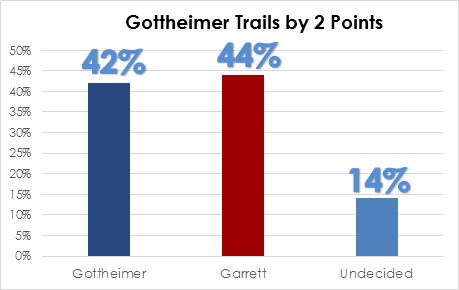
With less than 100 days to go in the general election season, Democrat Josh Gottheimer has pulled into a virtual tie with Republican Scott Garrett (Gottheimer 42%, Garrett 44%), according to a DCCC survey of likely general election voters in New Jersey’s 5th Congressional District.
As Garrett’s favorability drops among NJ-05 voters, likely due to his vote against healthcare for 9/11 first responders, his outspoken bigotry, and his refusal to bring tax dollars back to the district for roads, bridges, schools, and fire departments.
Gottheimer has much more room to pick up support as more voters learn about his message. Undecided voters, who represent 14% of voters in this district, favor Hillary Clinton over Donald Trump by a wide margin. Voters who are familiar with Gottheimer prefer him over Garrett, 53% to 43%. Younger voters, women, and minority voters, all of whom make up significant portions of the district’s population, support Gottheimer strongly and their support can grow as more voters learn about Garrett.
GARRETT’S POPULARITY IS DROPPING
Garrett’s popularity is in the negative, or barely above water, among women (-5 net, 32% favorable, 37% unfavorable), voters under the age of 55, minority voters, and in the key Bergen County, which represents over 70% of the district’s voters. Gottheimer, in contrast, is disproportionately popular among these same groups, with a 1.7-to-1 ratio of favorable to unfavorable among younger voters and a 1.9-to-1 favorable to unfavorable ratio among women.
The data in this memo is from a survey of 508 likely 2016 General Election voters conducted August 2-3 in New Jersey’s 5th Congressional District. Respondents’ information came from the voter file and respondents were interviewed over the phone via either a live or an automated survey. The margin of error is ± 4.3 percent.