
“Serving in the minority is not fun”
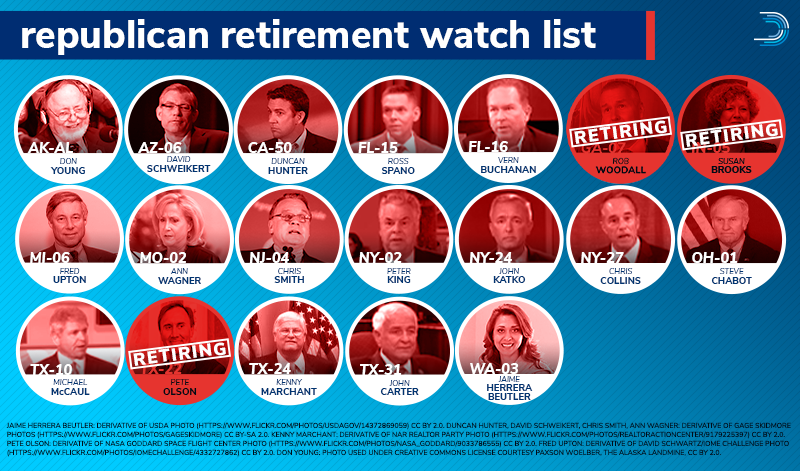
The Houston Chronicle reported on Rep. Pete Olson’s recently announced retirement and concluded he likely won’t be the last congressional Republican to throw in the towel.
Please see below for excerpts from the Chronicle’s assessment of Congressional Republicans’ situation as the August Recess begins:
By Jeremy Wallace
July 29, 2019
U.S. Rep. Pete Olson, R-Sugar Land, won’t be the last retirement in Congress if recent history is any indication.
In years after a big power shift in the U.S. House, the number of retirements for the former ruling party typically spike. Since 1990, on average 11 Democrats and 12 Republicans retire from Congress every two years. But that number is much higher in years after members who have been in the majority are suddenly forced to live in the minority where they have less influence on public policy.
…
“Serving in the minority is no fun,” said Kyle Kondik, of the Center for Politics at the University of Virginia.
The party in the majority in Congress controls who will be Speaker of the House and sets the agenda for every committee and subcommittee in the House. That leaves those in the minority with little power to pass bills or even influence what issues will be debated.
Already seven members of Congress have announced they are retiring before 2020, five of them Republicans.
Kondik said another factor is that some members who are suddenly are in the minority are facing tougher races to win re-election, as is the case with Olson. In 2016, Olson cruised to an 18-percentage point victory. But in 2018, that was chipped down to just 5 percent in the fast-growing 22nd Congressional District that has become one of the most diverse districts in the nation.
Demographic data shows that 26 percent of the 22nd District is Hispanic, 19 percent are Asian and 12 percent black.
Democrats were already preparing to target Olson in 2020. But now, with Olson out, national experts say the 22nd District is a pure toss-up heading into 2020.
…
Texas is coming off a 2018 cycle that shook up its 36-member Congressional delegation. Six Republicans and two Democrats did not seek re-election in 2018, and two Republican incumbents were defeated in the general election.
Several other Republican members of Congress who had cruised to victory in previous cycles narrowly won their re-elections in 2018. U.S. Reps. Michael McCaul of Austin; John Carter, of Rock; Chip Roy of Austin; Will Hurd of San Antonio; and Kenny Marchant of Coppell all won their 2018 races by 4 percentage points or less.
If you’re wondering who we’ve got our eye on, you can view the DCCC’s Retirement Watch List HERE.
###