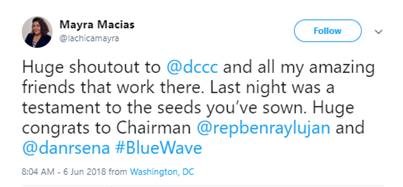
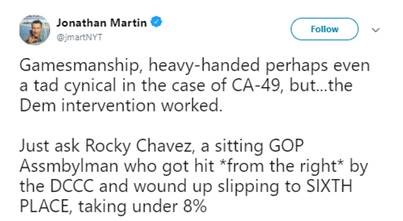
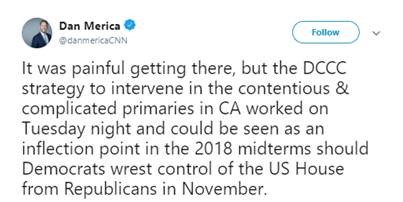
In case you missed it, reporters, election forecasters, strategists, and allies were all in agreement yesterday – the DCCC’s strategic investment in California paid off and puts Democrats in a strong position to take back the House in November.
Take a look at some of the coverage below:
National Journal: Democrats Look to Rack Up Blue-State Wins
[…] That result is a testament, in part, to the extraordinary targeting efforts by the Democratic Congressional Campaign Committee and state party.
CNN: Crisis averted: How the Democrats avoided disaster in California
But Kelly called it money well spent.
“We have set ourselves up to win multiple seats in California in November, and we wouldn’t have been able to go to the final match if we hadn’t gotten Democrats through,” she said. “It would have been over.”
[…] Aaron McCall, chairman of Indivisible OC 48, sang the committee’s praises on Wednesday morning, cheering its decision to jump in only “after following the lead of the grassroots.”
“We felt like the DCCC worked as a brilliant collaborative partner to equalize a race where a decision was made too early by the CA Dems,” he said, referencing the California state party’s controversial endorsement of Keirstead back in February.
NYT: Democrats Strengthen House Takeover Prospects in Primary Voting
Democratic strategists in Washington deserve some credit for their efforts to knock down the biggest threats in California. […] National Democrats also pumped in money to knock down a second-tier Republican, clearing the field for Democrats to fight it out for second place.
[…] In the end, the D.C.C.C. and a pair of Democratic political action committees working jointly, the House Majority PAC and Priorities USA Action, spent over $7 million to knock down Republican candidates and lift their own contenders in three districts: Mr. Rohrabacher’s, Mr. Issa’s and Mr. Royce’s. In all three, a second Republican faded in the final results.
LA Times: Democrats avoid nightmare scenario in California, boosting their hopes to seize the House
The danger of a shutout was real, however, and national Democrats intervened aggressively, endorsing some candidates, coaxing others to step aside and spending copiously to thwart all-Republican general election contests that would have taken those coveted seats off the table.
“It’s easy to look back and say there was too much hype about Democrats getting locked out,” said Nathan Gonzales, who analyzes congressional races nationwide for his nonpartisan tip sheet, Inside Elections. “But Democrats had to spent several million dollars preventing that catastrophe from happening.”
It’s a good bet they woke up Wednesday pleased with their investment.
Politico: ‘This is basically a home run for Democrats’
The election resolved the party’s difficulty managing large fields of Democratic candidates who threatened to splinter the primary vote. Weighing in to shape the primary fields, the DCCC endorsed favored candidates and dropped $7 million to make sure those districts remained on the battlefield in November.
[…] The prospect of a Democratic lock-out weighed heavily over the Democratic Party for much of the year, with party leaders lobbying Democrats to reconsider their candidacies and intervening more forcefully in recent weeks.
It paid off on Tuesday night.
Slate: How Democrats Beat the System in California
After Tuesday night’s primary, it appears that the Democratic Party has pulled it off: Democrats won’t be “locked out” of any critical November congressional races in California. Though ballots will continue arriving in the mail for days, and it’s not clear in one key district which Democrat will advance into the top two, Democrats are on track to avoid any embarrassments. This took a lot of work.
[…] If all of these results hold and Democrats avoid any lockouts in critical races, expect some discussion of how the threats were “overhyped.” But it took Democrats months of exhausting work to narrow candidate fields and consolidate around candidates, and the expenditure of many millions of dollars, to get here. The threats were real, and ably surmounted.
NYT: 5 Takeaways From Tuesday’s Primary Elections
National Democrats spent over $7 million in an effort to ensure they had a candidate reach the general election in three House districts in California held by Republicans. Their decision to not take their chances in the state’s “top two” system — in which the top finishers in nonpartisan, open primaries face each other in November — appears to have been a wise investment.
[…] It did not come cheap, but if Democrats secure a narrow House majority in November they will have done so in part because they decided to aggressively compete in June.
Washington Post: California rewards front-runners in top races, but contested House districts are likely to be unresolved for days
Democrats appeared poised to overcome the obstacles of the state’s unorthodox primary system — where the top two vote-getters advance regardless of party — and claim slots on the November ballot in key districts.
Scores of Democrats are running across the state, and party committees spent millions in recent weeks and scrambled over the course of months to thin the crowded fields of candidates and avoid being locked out of the November ballot in some districts.
NBC News: Nine big takeaways from last night’s primaries
Give credit to the often-criticized DCCC: Not making the Top 2 was a legitimate threat in all three districts, but they did what they needed to do to avoid blowing winnable contests in November.
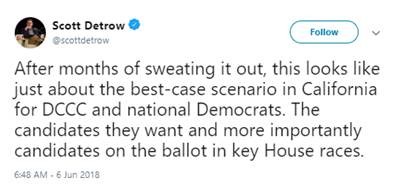
https://twitter.com/scottdetrow/status/1004359339774283776
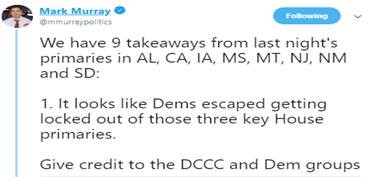
https://twitter.com/mmurraypolitics/status/1004339205483483137
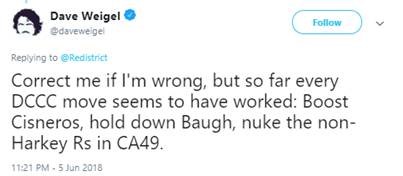
https://twitter.com/daveweigel/status/1004246786763034627
https://twitter.com/jmartNYT/status/1004389617301196800
https://twitter.com/danmericacnn/status/1004483244480516097